
What must a UK VAT invoice include?
When you're VAT-registered, your invoices must include specific information beyond standard invoice requirements. Missing these details means the invoice isn't valid for VAT purposes — your client can't reclaim the VAT, and you could face compliance issues.
HMRC specifies exactly what VAT invoices must contain. There's no flexibility on these requirements — they're legal obligations for every VAT-registered business.
Standard VAT invoice requirements
For invoices over £250 (including VAT), you must include:
- A unique invoice number: Sequential, never reused
- Invoice date: When you issue the invoice
- Date of supply (tax point): When the goods were delivered or services were completed (if different from invoice date)
- Your business name and address: As registered with HMRC
- Your VAT registration number: Format GB 123 4567 89
- Client's name and address: The entity being invoiced
- Description of goods or services: Clear, detailed enough to identify what was provided
- Quantity: Number of items, hours, days as applicable
- Unit price excluding VAT: Price per item/hour/day
- Rate of VAT: Usually 20% standard rate
- Total amount excluding VAT: Net total
- Total amount of VAT: Separate line
- Total amount including VAT: Gross total
Full VAT invoice example
Here's a complete example of a correctly formatted VAT invoice:
VAT INVOICE
From:
Digital Solutions Ltd
25 Tech Park Road
Manchester, M1 4DE
Company No: 12345678
VAT Registration No: GB 987 6543 21
Bill To:
Enterprise Corp Ltd
200 Business Avenue
London, EC1A 1BB
VAT No: GB 111 2222 33
Invoice Number: DS-2026-0147
Invoice Date: 14 February 2026
Tax Point: 14 February 2026
Due Date: 16 March 2026
Description of Services:
| Web application development — February 2026 | 12 days | @ £450/day | £5,400.00 |
| API integration and testing | 3 days | @ £450/day | £1,350.00 |
| Documentation and handover | 1 day | @ £450/day | £450.00 |
Net Amount (excl. VAT): £7,200.00
VAT @ 20%: £1,440.00
Total Amount Due: £8,640.00
Payment Details:
Barclays Bank
Account Name: Digital Solutions Ltd
Sort Code: 20-00-00
Account Number: 98765432
Payment terms: Net 30 days. Late payments may be subject to statutory interest under the Late Payment of Commercial Debts (Interest) Act 1998.
This invoice contains every required element: unique numbering, your VAT details, client details, itemised description, clear VAT breakdown, and payment information.
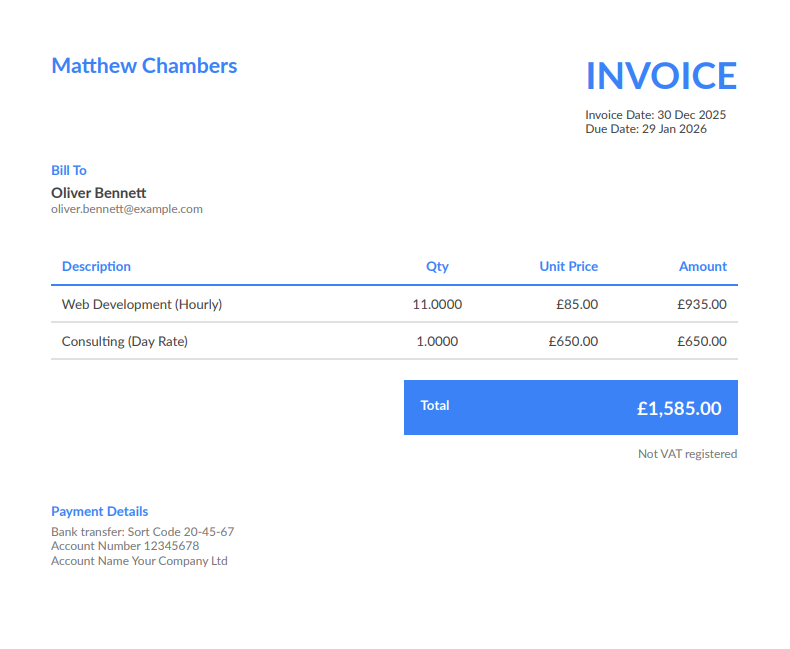
Simplified VAT invoice example
For sales under £250 (including VAT), you can issue a simplified invoice with fewer requirements:
TAX INVOICE (Simplified)
Digital Solutions Ltd
25 Tech Park Road, Manchester, M1 4DE
VAT No: GB 987 6543 21
Date: 14 February 2026
Invoice: DS-2026-0148
Consultation call (1 hour)
Total (inc. VAT @ 20%): £180.00
Simplified invoices can show VAT-inclusive prices without separating the net and VAT amounts. They still need your VAT number, date, and description — but client details and line-by-line breakdowns are optional.
Standard vs simplified: when to use each
The decision is straightforward:
- Invoice £250 or more (inc. VAT): Must use full VAT invoice format
- Invoice under £250 (inc. VAT): Can use simplified format
- Client requests full invoice: Always provide full format if asked
- B2B transactions: Full format preferred — clients need details to reclaim VAT
For most freelancers billing business clients, full VAT invoices are standard regardless of amount. Simplified invoices are more common in retail or for small one-off services.
VAT rates explained
The UK has three VAT rates. Understanding which applies to your services ensures correct invoicing:
Standard rate: 20%
Most goods and services, including the majority of freelance work: design, development, consulting, marketing, writing, photography. If you're unsure, this is almost certainly your rate.
Reduced rate: 5%
Specific categories like children's car seats, energy-saving installations, and some sanitary products. Rarely applies to freelance services.
Zero rate: 0%
Books, newspapers, children's clothing, most food. Some digital publications may qualify. You're still VAT-registered and can reclaim input VAT, but you charge 0% to customers.
Exempt services
Insurance, financial services, education, and healthcare are VAT exempt. You don't charge VAT, but you also can't reclaim VAT on related purchases. Different from zero-rated.
For freelancers in typical creative, tech, or consulting fields: standard rate (20%) applies to virtually all your work.
International VAT considerations
VAT treatment changes for international clients:
EU business clients (post-Brexit)
B2B services to EU businesses are generally "outside the scope" of UK VAT. You don't charge VAT. Your invoice should note this: "Reverse charge: customer to account for any VAT due under local rules." Keep records of the client's VAT number and business address.
Non-EU international clients
B2B services to businesses outside the EU are also outside the scope. No UK VAT charged. Keep evidence these are genuine business clients.
Consumers (B2C)
Selling services to individual consumers overseas can have complex VAT rules depending on the service type. Most freelancer work is B2B, but if you sell to consumers, check the specific rules.
Common VAT invoice mistakes
These errors create compliance problems and delay client payments:
Missing VAT number: Every VAT invoice needs your registration number prominently displayed. Without it, clients can't reclaim VAT.
Wrong VAT calculations: Manual maths leads to errors. £1,000 + 20% = £1,200, not £1,220. Use software that calculates automatically.
Not separating net and VAT: Full VAT invoices must show the net amount and VAT amount separately. "£1,200 including VAT" isn't sufficient for invoices over £250.
Missing tax point: If the supply date differs from the invoice date, you need to show both. This affects which VAT period the transaction falls into.
Editing sent invoices: Altering a VAT invoice after sending it is a compliance violation. Issue credit notes and new invoices instead.
Charging VAT when not registered: This is illegal. If you're below the VAT threshold, don't include VAT numbers or charge VAT on invoices.
How FreelancerHub handles VAT invoices
FreelancerHub removes the complexity from VAT invoicing:
Automatic VAT calculations
Enter your prices, VAT calculates correctly. No manual maths, no errors.
Proper formatting
Net, VAT, and gross amounts displayed correctly on every invoice.
Your VAT number included
Stored in settings, appears automatically on every invoice.
VAT reporting
Track VAT collected across periods for easy return preparation.
International handling
Set VAT treatment per client — UK standard, EU reverse charge, or outside scope.
Tax point dates
Specify supply dates when they differ from invoice dates.
Frequently Asked Questions
What's the difference between a VAT invoice and a normal invoice?
A VAT invoice includes your VAT registration number, the VAT rate applied, and the VAT amount shown separately. Non-VAT invoices just show the total amount without any VAT split. If you're VAT-registered, you must issue VAT invoices for most B2B sales.
Do I need to show VAT per line item?
For standard VAT invoices over £250, yes — you should show the VAT rate and amount for each line item, or group items by VAT rate. For simplified invoices (under £250), a single VAT total is acceptable. Most invoicing software handles this automatically.
What's a simplified VAT invoice?
A simplified invoice can be used for sales under £250 (including VAT). It requires fewer details: your name/address/VAT number, date, description of goods/services, and VAT-inclusive amounts. You don't need to show the VAT rate or separate the net amount.
Can I issue VAT invoices if I'm not VAT-registered?
No. Only VAT-registered businesses can issue VAT invoices. Showing a VAT number or charging VAT when you're not registered is illegal. If clients ask for a VAT invoice and you're not registered, explain that you're below the threshold.
What VAT rate do I charge on freelance services?
Most freelance services are charged at the standard rate of 20%. Some services (like certain exports, charity work, or specific industries) may be zero-rated or exempt. If in doubt, assume standard rate applies — it covers the vast majority of freelance work.
How do I correct a VAT invoice with errors?
Never alter a sent VAT invoice — this is a compliance issue. Issue a credit note referencing the original invoice number, then issue a new corrected invoice. Keep all documents on file. This maintains the audit trail HMRC expects.